|
 Puccinia wahlenbergiae Puccinia wahlenbergiae
BiostatusPresent in region - Indigenous. Endemic
Images (click to enlarge)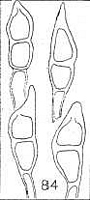
Caption: FIG. 84. Puccinia Wahlenbergiae G.H. Cunn. on Wahlenbergia albomarginata Hook
Teleutospores. |
Article: Cunningham, G.H. (1924). The Uredinales, or rust-fungi, of New Zealand: supplement to Part 1; and Part 2. Transactions and Proceedings of the New Zealand Institute 55: 1-58 Wellington:.
Description: 0. Unknown.
III. Teleutosori hypophyllous, caulicolous, and on inflorescences, on leaves orbicular; 1 mm.
diam., scattered, on stems linear, 1.5 mm. long compact, pulvinate, pallid brown, naked or
surrounded by the ruptured epidermis. Spores fusiform or subclavate, 35-50 X 12-19 mmm.;
apex strongly acuminate, thickened up to 18 mmm., base attenuate; slightly or not constricted
at the septum; epispore smooth, hyaline, or tinted brown, 1-5-2 mmm. thick, cell-contents
vacuolate, tinted brown; pedicel persistent, continuous with the spore, hyaline, stout, up to 30
X 10 mmm.; germ-pore of the upper cell apical, conspicuous, basal pore immediately beneath
the septum, obscure.
Notes: The host is endemic, and is abundant in hilly and mountainous country throughout.
(Cheeseman, 1906, p. 403.)
This rust is characterized by the strongly acuminate apex and persistent stout pedicels of the
teleutospores.
Article: Dingley, J.M. (1969). Records of plant diseases in New Zealand. New Zealand Department of Scientific and Industrial Research, Bulletin 192: 298 p. Wellington:.
Notes: The rust is known only from Tongariro National Park in the centre of the North Island. The
host [Wahlenbergia albomarginata] is endemic and abundant throughout the mountain
districts in both islands.
|