|
 Puccinia atkinsonii Puccinia atkinsonii
SynonymsAecidium macrodontae
Puccinia heketara
BiostatusPresent in region - Indigenous. Endemic
Images (click to enlarge)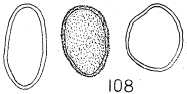
Caption: FIG. 108. Aecidium Macrodontae G.H. Cunn. Aecidiospores from Olearia macrodonta
Baker. | 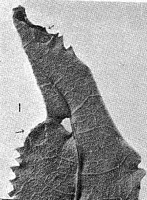
Caption: FIG. 1.-Aecidium Macrodontae G.H. Cunn. on Olearia macrodonta Baker. | 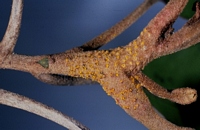
Caption: Puccinia atkinsonii on Olearia rani PDD68244
Owner: Herb. PDD |
Article: Gadgil, P.D. (in association with Dick, M.A.; Hood, I.A.; Pennycook, S.R.) (2005). Fungi on trees and shrubs in New Zealand. Fungi of New Zealand. Ngā Harore o Aotearoa 4: xi + 437 p. Hong Kong: Fungal Diversity Press.
Description: Type: Rust and Smut Fungi; Description: Aecia in crowded groups, bright orange, on distorted spots up to 3 cm long; on leaves, petioles, and shoots. Aeciospores subglobose, elliptical or tear-shaped, 25–33 × 20–28 m, densely verrucose, hyaline. Telia crowded, minute, circular, dark chocolate brown, powdery, up to 1 mm in diameter; buried in dense tomentum on the lower surfaces of leaves. Teliospores broadly elliptical, 1-septate, 40–65 × 20–35 μm, pallid chestnut brown; pedicel deciduous.
Distribution: Distribution: Northland, Auckland, Coromandel, Bay of Plenty, Taranaki, Taupo, Wellington, Hawkes Bay, Nelson, Westland, Fiordland, Marlborough Sounds, Marlborough, Dunedin.; 1st Record: Cunningham (1923a).
Article: Dingley, J.M. (1969). Records of plant diseases in New Zealand. New Zealand Department of Scientific and Industrial Research, Bulletin 192: 298 p. Wellington:.
Notes: This endemic rust species is common throughout New Zealand on Olearia spp. It
may cause considerable distortion to shoots and leaves. As host plants are only
under shrubs in the indigenous forest, the rust is of no economic importance.
Cunningham (1924a) described the aecidial stage on Olearia macrodonta as
Aecidium macrodontae: he (1924b) described this rust on Olearia rani (syn. O.
cunninghamii) as Puccinia heketare. He liter (1931a) listed these species as
synonyms of P. atkinsonii.
Article: Cunningham, G.H. (1924). The Uredinales, or rust-fungi, of New Zealand: supplement to Part 1; and Part 2. Transactions and Proceedings of the New Zealand Institute 55: 1-58 Wellington:.
Description: 0. Spermogones amphigenous, chiefly epiphyllous, sparse, associated with the aecidia.
I. Aecidia hypophyllous and petiolicolous, crowded in irregularly-shaped groups up to l0 mm.
long, seated on discoloured distorted spots visible on the upper surface, pallid yellow. Peridia
immersed, the margins alone showing, 0-1-0-2 min. diam., margins incurved, dentate, white.
Spores polygonal, elliptical, or obovate, 25-37 X 18-24 mmm.; epispore hyaline, densely and
rather coarsely verruculose, 1 mmm. thick, cell-contents tinted yellow, granular.
Notes: The host is endemic, and is abundant throughout. (Cheeseman, 1906, p. 286.)
This species is separated from Aecidium Oleariae McAlp. on account of the much larger
spores. Moreover, the minute immersed peridia and distorting habit are distinctive features.
|